A house fire is among the most traumatic events a property owner can experience. Even after the flames are extinguished, the damage continues smoke penetrates deep into materials, soot corrodes surfaces, and firefighting water saturates whatever the fire didn’t destroy. For Indio residents, understanding what fire damage restoration truly involves helps set realistic expectations and supports better decision-making during an emotionally overwhelming time.
The Hidden Nature of Fire Damage
Most people focus on what the flames burned. In reality, a significant portion of fire damage and a substantial part of the restoration challenge comes from smoke and soot. Smoke is not a single substance. It is a complex mixture of gases, particles, and chemical compounds that varies depending on what burned. Synthetic materials like plastics and foams produce sticky, acidic smoke with a particularly invasive odor. Natural materials like wood produce drier soot that, while easier to clean, can penetrate deeply into porous surfaces.
Soot is acidic. Within hours of a fire, soot deposited on metal surfaces begins to cause corrosion. Fabrics begin to permanently discolor. Porous materials like drywall, insulation, and wood absorb smoke compounds that require specialized treatment to neutralize. This is why Fire Damage Restoration Indio is not simply a matter of cleaning what is visibly dirty it involves systematic treatment of every affected surface and material in the structure.
Southern California’s Fire Risk Context
California has long grappled with wildfire risk, and while Indio itself is an urban desert community, the surrounding Coachella Valley region is no stranger to fire events. Dry, windy conditions particularly during Santa Ana wind events create conditions where residential fires can spread quickly. Additionally, the extreme heat of Indio summers creates fire risks from electrical equipment overheating, air conditioning systems under stress, and vegetation that dries completely during the hottest months.
Kitchen fires, electrical fires, and appliance-related fires account for the majority of residential fire events in communities like Indio. Understanding the specific nature of the fire what burned, at what temperature, and for how long shapes the entire restoration approach.
Phase One: Assessment and Safety
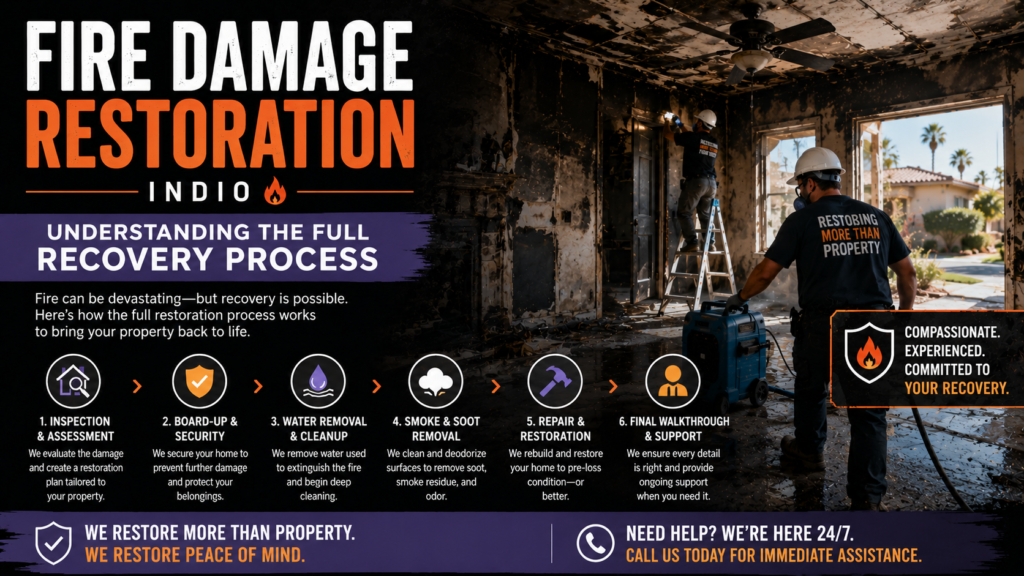
Before any restoration work begins, the property must be assessed for structural safety. Fire degrades the integrity of building materials. Roof assemblies may be compromised. Floor structures may have weakened. Walls may be unstable. A thorough assessment determines which areas of the structure are safe to enter and work in, and identifies structural elements that require shoring or immediate repair before other work can proceed.
This assessment also identifies all areas affected by smoke and soot which, in many fires, extends significantly beyond the area of active burning. Smoke travels through HVAC systems, under doors, and through penetrations in walls, distributing fine particles and odors throughout an entire structure even when only one room was directly involved in the fire.
Phase Two: Securing and Stabilizing the Property
Fire-damaged properties require immediate securing. Structural openings created by the fire holes in roofs, missing windows, damaged walls must be boarded or covered to prevent weather intrusion, theft, and unauthorized entry. This board-up work is a standard early step in fire damage restoration and is often covered by homeowners’ insurance.
In Indio’s desert climate, an unsecured fire-damaged home faces additional risks. Daytime temperatures that regularly exceed 100°F in summer can accelerate the breakdown of already weakened materials. Securing the structure promptly helps prevent compounding damage.
Phase Three: Water Removal from Firefighting
Firefighting water creates a secondary damage event on top of the fire itself. Hoses deliver enormous volumes of water in a short period, saturating materials throughout the affected areas. This water must be extracted and the structure must be dried using the same professional equipment and methodology applied in standard water damage restoration air movers, dehumidifiers, and continuous moisture monitoring.
Failure to properly dry a fire-damaged structure before reconstruction creates conditions for hidden mold growth behind new materials a costly and health-threatening outcome that is entirely preventable with proper drying protocols.
Phase Four: Smoke and Soot Cleaning
This phase is one of the most technically demanding aspects of fire damage restoration. Different surfaces require different cleaning approaches. Dry cleaning sponges remove loose soot from walls and ceilings without smearing. Chemical sponges and specialized cleaning agents dissolve and lift adhered soot from harder surfaces. Ultrasonic cleaning equipment is used for salvageable belongings including electronics, jewelry, and decorative items.
HVAC systems require particular attention. Ductwork that distributed smoke throughout the home during the fire must be thoroughly cleaned before the system is operated again otherwise, running the HVAC simply redistributes smoke residues and odors throughout the restored space.
Phase Five: Odor Neutralization
Smoke odor is not simply a nuisance. It is a sign that smoke compounds remain present in the structure. Masking odors with deodorizers does not constitute successful odor remediation the source compounds must be neutralized or removed.
Professional fire restoration teams use several technologies for odor control. Hydroxyl generators produce hydroxyl radicals that react with and neutralize odor-causing compounds at the molecular level. Thermal fogging introduces a deodorizing fog that penetrates the same porous areas the smoke originally reached. Ozone generators, used in unoccupied spaces, oxidize odor molecules effectively.
Phase Six: Reconstruction
Once all cleaning, drying, and deodorization is complete and verified, reconstruction begins. The scope varies dramatically depending on the fire’s extent. Some properties require only cosmetic repairs repainting, carpet replacement, and fixture cleaning. Others require removal and replacement of drywall, insulation, flooring, roofing, and structural framing.
In Indio, all reconstruction work must comply with current California Building Code requirements, which have been updated significantly in recent years to address fire safety, energy efficiency, and seismic standards. This means that in some cases, reconstruction of a fire-damaged home must bring the repaired sections up to current code standards that exceed what was originally installed.
What Indio Residents Should Know About the Restoration Timeline
Fire damage restoration timelines vary based on the scope of damage, the availability of materials, and insurance processes. Minor fire events affecting a single room may be resolved in one to two weeks. Major losses involving structural damage may require several months of restoration work. Understanding this reality helps property owners plan for temporary housing and manage expectations during the process.
Throughout all phases, documentation is essential. Photographs, moisture readings, cleaning logs, and material inventories support the insurance claims process and create accountability for the quality of work performed. Indio property owners experiencing fire damage should ensure they retain copies of all documentation generated throughout the restoration process.
Fire damage restoration is a complex, multi-phase discipline that goes far beyond cleaning and repainting. Understanding its full scope empowers property owners in Indio to engage more effectively with restoration professionals, insurance adjusters, and contractors and ultimately to achieve the best possible outcome from a genuinely difficult situation.